
From a Unix Terminal at NIH to the White House
A dining guide built in 1994, a business started because the rent was due, and the customers who found it without being asked.
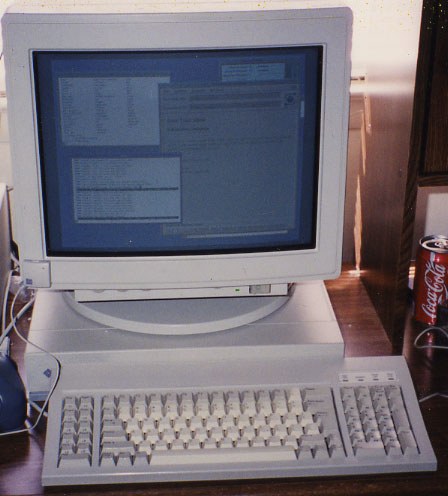
Where my journey started: a Unix terminal in 1994
In 1994, about six years after I finished my undergraduate degree in business and finance, I had access to a Sun Sparc Unix terminal at the National Institutes of Health, where I was working as a computing researcher. That meant I had access to the internet at a point when almost nobody outside a university did. The World Wide Web had been invented five years earlier by Tim Berners-Lee. The network itself had only gone commercial the year before, after the US Congress authorized its use for commercial purposes.
For the first time, anyone could build a website. So I built one — a restaurant review guide to Washington DC, put together with another scientist at the lab. It got noticed. I remember meeting with a food and wine editor from a magazine who loved it.
I then tried to sell the idea of a series of web-based dining guides to major publishers. I got real interest from two of them — Fodor's, the major travel guide, published by Random House, and Zagat, the leading customer-review restaurant guide. I actually spoke with Tim Zagat, the publisher himself. Interest, and then no action taken. That was my first experience of a good meeting that goes nowhere, and it would not be my last, although I did register a copyright on the property. It was probably the first online dining guide ever copyrighted, long before Yelp or TripAdvisor existed.
It is worth pausing on what that first website actually was, because it is the same thing I have been doing ever since. It was a list of items, described well enough that a stranger could find the one they wanted. Not a campaign. Not persuasion. A structured catalog with good metadata. Had I not taken it down in 1995, and had I expanded it nationally, it would probably be one of the most heavily visited restaurant guides on the internet by now. Thirty years later I would be doing precisely the same thing with three hundred thousand products in an internet business I started later. But only in the past few years have I begun to understand the deeper analytics lying underneath all of it.
2001
In 2001, I started the business I still run today. It was a few months before 9/11. There was a credit card as capital, little plan and no runway. I started to help pay the rent. It was before Mark Zuckerberg started at Harvard and created Facebook. Before LinkedIn. Before people even cared about Internet marketing, let alone marketing analytics.
It worked out, faster than I expected. Sales came on the very first day, in July of 2001, on eBay, then fast and furious through the first months. Five figures in the first month. Six figures in the first year. For the first two years I worked seven days a week, ten to twelve hours a day, printing and packing and shipping out of my living room. I have never taken that for granted, because I know exactly what the alternative looked like.
In 2004 I moved to Boston. From 2006 I sold through the large marketplaces, Amazon in particular, as well as business to business directly to retailers.
By 2016 I had earned 7 figures in cumulative revenue on Amazon, without any advertising, based on technical and metadata preparation alone. However, competition arose and the business was closed so I could focus on analyzing what I had done and finding a path to scale beyond Amazon.
I spent the years afterward pulling together fifteen years of metrics from it, which is a strange thing to do with a business you have shut, and which turned out to be the most valuable work I have ever done. Daily sales had kept me so preoccupied for ten years that I never had the chance to analyze things. The tools to do so were not well defined yet either. Doing this is why I can now say precisely what happened rather than approximately.
That gap is worth naming, because it is the most common failure I see in small businesses now. No one has the time to do their own analysis. It is also getting too complex to figure out how to do. Fifteen years of operating produced fifteen years of data, and I looked at almost none of it. I was too busy shipping to pull it all together.
The pandemic stopped almost everything. In 2022 I left Boston for rural Maine. In 2023 I restarted the Amazon business, and I started the graduate work in a digital marketing analytics program that gave me the method to check what all of it had actually taught me.
The first vantage point: who actually bought
I ran a niche business. I sold reproductions of old maps, photographs, prints and artwork that are in the public domain. The images come from the Library of Congress, which has been digitizing millions of images from its shelves going back to the 1800s. I have been cataloging these images since 2001 and there are now more than three hundred thousand of them in my archive. That business has sold to tens of thousands of customers in more than fifty countries.
The business is Snapshots of the Past, and there is a fuller history of the journey on the website at snapshotsofthepast.com.
I was one of the first to take historic prints and reproduce them as a way to satisfy an individual's nostalgia, or longing for the past. A scholarly article has been written about what I do, called “On Nostalgia”.
| Who bought | What it taught |
|---|---|
| The White House | I was selected as a vendor for art print evaluation on the 2008 White House redecoration project. Getting through an institutional procurement screen is its own achievement, and it is not the same as a sale — the evaluation runs a year and almost all of it is invisible to you. |
| Harvard, the New York Public Library, the Metropolitan Museum of Art, the National Park Service | Institutional buying runs on a calendar and a reference check. It takes a year, and it is worth it, and almost nobody has the patience for it. I sold to the National Park Service alone for over ten years. |
| HBO, NBC and FOX | Production buyers need certainty about rights more than they need a good picture. Answer that first and you are already ahead. |
| Cracker Barrel and hundreds of other retailers | Wholesale is a different business from retail wearing the same clothes. Different terms, different volumes, different reasons for saying no. |
| The president of Panama | An important person, one order, from a country I had never shipped to, or been to. A catalog that is findable is findable from everywhere. |
| The mayor of Miami Beach | Public figures buy things for their offices like anyone else. The order looked exactly like any other order until I read the name. |
| A customer in Greenland | Greenland is in the news these days, though not for retail marketing. Fifty-six thousand people live there. One of them found a historical image from a small operation in Maine and bought it. I also learned that mail arrives there on a once-a-week cargo flight from Denmark. |
Here is the part that matters. I did not sell to any of them because of a campaign. There was no outbound effort aimed at the president of Panama. What there was instead was carefully structured metadata, a catalog of three hundred thousand items described carefully enough that people looking for something specific could find it. That is it. The long tail.
I was written up early on in the Pittsburgh Post Gazette and a trade publication, Décor Magazine for my efforts. But otherwise, I did very little advertising or PR. And yet I still pulled in 7 figures overall before I closed. That says something. A business was based around the long tail.
And the long tail is where the analytics get interesting, because it is the part most reporting hides. Aggregate numbers make a catalog look like its top sellers. Break the same data out by item and you find that a large share of revenue comes from things that sell once or twice a year — and that those are the orders most likely to come from somewhere remarkable. The Greenland order is not a charming outlier. It is what the distribution actually looks like once you stop averaging it.
What a global customer list teaches that a campaign cannot
- Findability beats persuasion when the customer already knows what they want. Most of my best orders came from people I never spoke to. That is a strategic claim, and it decides where a small business should spend.
- Description is the product. In a catalog business, how a thing is written about determines whether it exists at all. Metadata quality is a revenue variable, not a housekeeping task.
- The institutional buyer and the consumer are not on a spectrum. They are different species with different journeys, different cycle lengths and different decision units. Treating them as one segment loses both.
- Reach costs nothing extra once the catalog is right. Fifty countries did not require fifty marketing plans. It required one structure that worked when nobody was watching.
- Answering your own customer service mail for twenty-five years is a research method. It is the only channel where people tell you, unprompted and in their own words, exactly where your product confused them.