
Twelve Years in the Front Seat
Ten thousand rides, the people in the back seat, and what you can only see from inside a two-sided marketplace.
A second vantage point: twelve years driving for Uber
For 12 of the past 25 years, I also did a side gig. I drove for Uber and Lyft — eight years in Boston and another four in Maine. More than ten thousand rides. Over two hundred thousand miles, through two hundred cities and towns, mostly around Boston and eventually all over New England. Riders from more than fifty countries, by my own count.
I have chatted with thousands of people in those rides, and I have said many times that I do not give rides to A-list Hollywood people. I give rides to people who are A-list in their own world. That is a better sample, because those are the people who actually decide things.
Among the B-listers, as I call them: executives from many Fortune 500 companies, professors, students, business travelers, tourists, locals. Here is a further sampling of these B-list people:
| Category | Who | What made it notable |
|---|---|---|
| Television, film and music | Ron Hicklin | Lead voice on the Happy Days theme. Also Laverne & Shirley, That Girl, Love American Style, voicings for the Monkees, and the theme to the original M*A*S*H film that became the series theme. His band also sang McDonald's “You Deserve A Break Today.” He said I could name him. |
| The wife of Mark Wahlberg's hairdresser | He was in town filming a movie. | |
| A rider who partied with Charlie Sheen | In Green Bay, Wisconsin. He texted me the photographs afterwards and said I could use them. | |
| Sports | A driver who lives across from Gronk | He gives rides to Gronk's physical therapist. |
| Julian Edelman, possibly | Another driver told me he thought he picked him up once. | |
| The mother of a Patriots player | In town to visit her son. | |
| Tom Brady, at three removes | A woman who had been in another car, where that driver had carried a rider who was on the phone with him. | |
| Internet and influence | RiceGum | Ten million subscribers on YouTube. He told me he was a gamer and I had to ask him what a gamer was. It took a dozen teenagers seeing his name in the journal before I understood. |
| Lilmayo | Two million followers on Instagram. A shirt designer, and the rider who finally explained to me who RiceGum was. | |
| Government | The former Haitian Ambassador to the United Kingdom | The most senior politician I have driven. Haiti and the UK only established relations in 2012. |
| Intelligence | A British military intelligence officer | Twelve years in Iraq and Syria. He said he spent most of it getting information out of people who did not want to give it to him. I did not ask any more questions. He is now a mild-mannered software man. |
| History and lineage | An Englishman near Harvard Square | His fourth great-grandfather fought at the Battle of Bunker Hill — for the British. He sent me the whole story. |
| A descendant of George F. Baker | Founder of Citibank, and the first benefactor of Harvard Business School. | |
| A relative of Neighbor Aber | From Mister Rogers. | |
| Los Angeles, at one remove | A Boston College swimmer | In a single ride: friends with Sylvester Stallone's daughter and with Larry King's son Chance; lived down the street from Kevin Hart, and from Lamar Odom and Khloé Kardashian when they were married; and his mother, a realtor, once showed a house to Serena Williams without knowing who she was. |
| Academia and technology | Harvard and MIT faculty and students | And people from every other college in the area. |
| Tech people off every flight | Google, Apple, IBM, Oracle, Red Hat, Microsoft. Boston is second only to San Francisco for technology and startups. I have a two-inch stack of business cards to show for it. |
If you want to read more stories, you can visit my Uber blog: bostonautotour.com, and a post I did about more semi-famous people I met. The rider journal itself is collected on the rider references page:
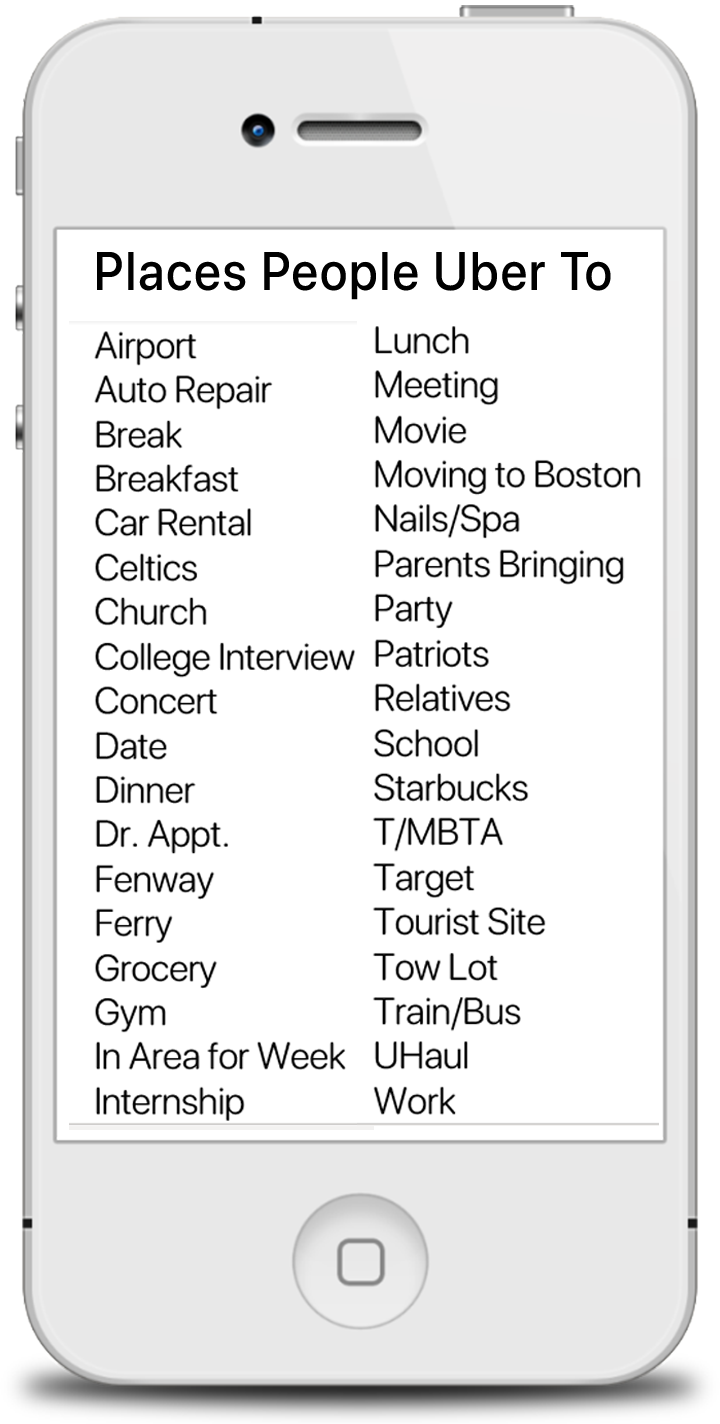
At the high end of the list I picked up the director of the US Department of Transportation's official research center, the Volpe Center in Cambridge, Massachusetts, who wanted my view on the region's traffic. A college president who asked me to design a course on driving for Uber - the first college-backed course of its kind in the country. A private equity analyst who worked through potential takeover targets with a client on the way to the airport. The Boston Globe has written about my blog – quoting me as an expert on Uber in the area – and the host of NPR’s All Things Considered in Boston, wanted to interview just before the pandemic broke out. The list goes on and on. The stories are endless. I have been working on a memoir about all of it, but the work of pulling the material into even an outline remains daunting.
How it started, including the part I got wrong
The story of how I got into the Uber thing is itself worth telling. Around Thanksgiving of 2013 I saw a Facebook ad offering twenty-five dollars an hour to drive. There is a curious irony in the fact that thirteen years later it has led to me starting a marketing analytics company. I was forty-seven. I had gone to college. Driving a cab did not strike me as a high-minded pursuit, and I will be honest that some of the hesitation was simple snobbery. I did not want people to know.
It took me three months to submit the paperwork. What finally moved me was not the money. It was that the company started texting me three times a day, every day, until I complied.
This annoyed me enormously. I had not given anyone permission. And then something happened I have thought about ever since: after about a week, I started looking forward to the texts. Somebody was paying attention to me. The irritation flipped into something else, and then I did the thing they wanted.
I have since sat in meetings where people debated whether a follow-up sequence was too aggressive. I have never once heard anyone describe what such a sequence feels like from the other end. I know exactly what it feels like. It worked on me, and I was hostile to it, and I could see it working, and it still worked.
That is worth more than it sounds. Every one of those texts was a data point in somebody's activation funnel, and in their reporting I appear as a conversion after roughly a fortnight of touches. What the report cannot contain is that the early ones made me angry and one somewhere in the middle flipped the whole thing. The shape of that response is invisible in the aggregate, and it is exactly what you would want to know before designing the next sequence.
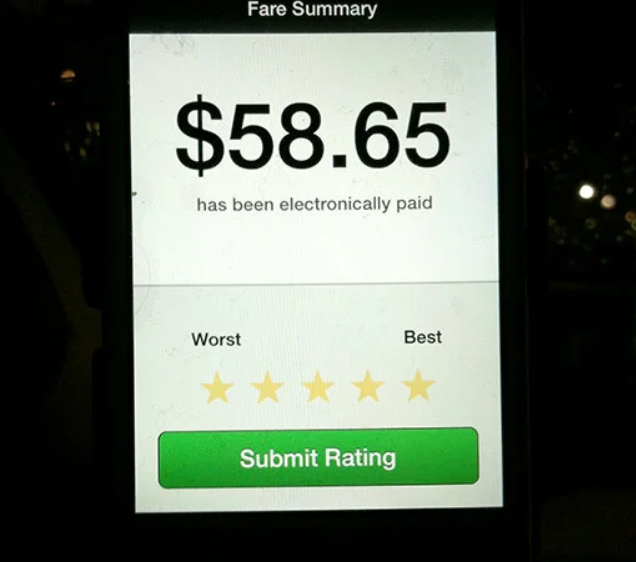
My first ride was on the fifth of February, 2014, at 2:13 in the afternoon, around Harvard Square. It paid six dollars and ninety-one cents, out of which I bought the gas. My first payout, ten days later, was fifty-eight dollars and sixty-five cents. I have never forgotten either number, and together they are the beginning of everything I understand about the difference between revenue and margin.
I’ve read the CEO of Uber has done a few rides as an Uber driver to see what it was like. I’ve done 10,000.
What the driver's seat shows you
Four things, and they compound.
You are on both sides of the transaction
I was a supplier on a two-sided marketplace and a customer of it at the same time. I was rated. I was priced. I was dispatched by an algorithm that never explained itself. I was given fifteen seconds to accept work, offered bonuses at thresholds designed to keep me driving past the point I wanted to stop, and penalized for cancelling by one company and not the other.
There is a very large literature on platform economics and almost all of it is written from outside. Uber is also not especially forthcoming with data to help researchers study the business. When I read about dynamic pricing I am reading about something that has taken money out of my pocket and put money into it on the same night, for reasons I could watch happening on a map on my dashboard. It is also, not incidentally, the same thing I have lived through as a marketplace seller for thirteen years on the other side of my business.
Being on both sides is what lets you tell a pricing model from a pricing story. Surge is usually explained as a demand response. From inside, it is also a supply-recruitment tool, and those two purposes produce different behavior at the edges. You cannot see that from the passenger seat and you will not find it in a public dataset.
Nobody knew they were being observed
Riders were not recruited. They were not paid. They did not know that when they got out I would sometimes dictate a note about what they had said. They did know I intended to publish something built on their journal entries — I told everyone who wrote in it that I was doing so, and nobody objected. Hundreds of them told me plainly that it was a project worth doing, and that they would pay money for what I was going to produce.
Whatever a paid focus group participant does to be helpful to the moderator, they did not do. There was no moderator — just a stranger driving, no eye contact, a fixed end time, and no consequences at all for saying what you actually thought. Those turn out to be close to ideal conditions for candor.
This matters because it addresses the largest known weakness in the data marketers usually rely on. Stated preference and revealed preference come apart, and every survey-based segmentation carries that gap inside it. What I have instead is a very large set of unprompted statements from people with no incentive to manage my impression of them. That does not make it representative. It makes it honest, which is a different and rarer property.
The range is impossible to buy
In one week I might drive the head of a federal research center, a cook working a summer visa with no other way to reach his job, a lobsterman, a teacher who used to own five Otto's pizza stores and took an enormous pay cut to walk away from them (and called himself the happiest he had ever been), and three actors traveling from New York to a physical theater school in a Maine town of a few thousand people. The stories never end.
A commercial panel would price that range out of reach, and a screener would exclude half of them for not fitting a category.
It ran for twelve years
I watched an entire industry mature one release at a time. First the custom iPhone Uber mailed me when I started and took a deposit on, then the first appearance of surge zones, then the arrival of food delivery, then the slow tightening of everything — all while our pay fell by half from what it was when we started. Uber used to hand every driver a huge stack of roses just before Valentine's Day, to give to riders. No more. Twelve years of anything is a longitudinal study. I did not know to call it that at the time.
Longitudinal is the word that matters. Most marketing measurement is one snapshot compared against another snapshot. Very little of it can tell you what a change felt like to the people it happened to, in order, over a decade.